 Why Israel
 Tech Ecosystem
 Human Capital
 Focus Sector
 The Health Network
 Business Opportunities
 Investment in Israel
 Innovation Diplomacy
 Leadership Circle
 Our Building
 Newsletter
 From The Press
 Startup Terms Glossary
 Tech Event Calendar


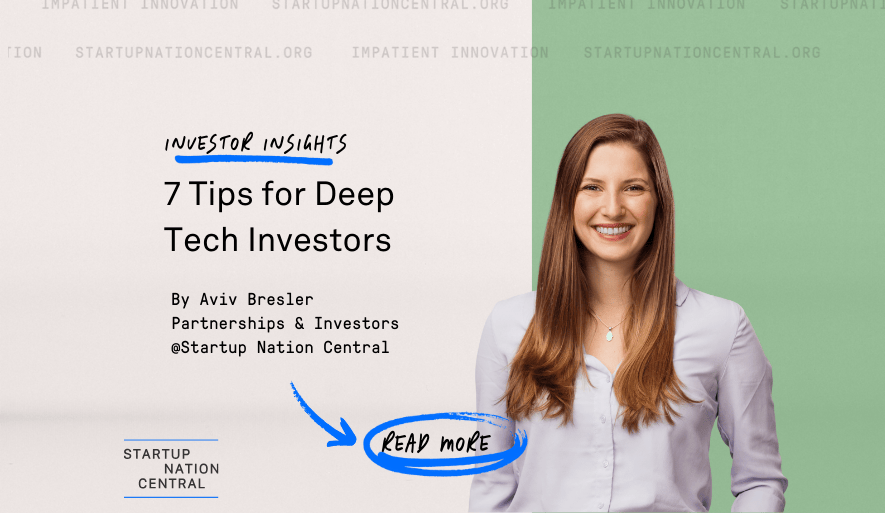
Deep tech investing demands a different mental model. These companies are not built for fast iteration or quick exits, but to solve structural problems through foundational science, often in environments where failure is expensive and timelines are long. Investors who succeed in this space adapt how they define risk, diligence founders, and support growth.
At our recent MNC Summit global investors, multinational executives, and Israeli founders met to examine how deep tech is built, funded, and scaled in practice. Across sectors and stages, a consistent message emerged: deep tech requires a different investment mindset, grounded in patience, translation, and long-term conviction. The following takeaways reflect what experienced capital allocators and operators shared about underwriting risk, supporting founders, and turning foundational science into scalable industry solutions.
1. Redefine Risk for Deep Tech Reality
In deep tech, risk sits in technical feasibility, adoption friction, and the time required to move from research to real-world deployment. Applying traditional venture benchmarks like speed or competition creates misalignment early.
Key realities investors must underwrite:
- Long R&D cycles before meaningful revenue
- High capital intensity in early stages
- Uncertain and nonlinear commercialization paths
- Regulatory and integration hurdles
The research to development framing is useful because it forces acceptance that SaaS style metrics do not apply. Progress looks slower, but defensibility compounds over time.
2. Customer Validation Is About Adoption, Not Design
Deep tech founders often hear strong customer interest early. That interest is valuable, but it is frequently misunderstood. Customers cannot define the solution, but they can define the pain, the friction, and the conditions required for adoption.
Strong diligence focuses on whether founders understand:
- Who the real buyer is versus the end user
- When a customer is willing to pay
- What proof points reduce customer risk
- What internal barriers block adoption
Backing deep tech means validating the commercial logic behind the technology, not confusing enthusiasm with readiness.
3. Investors Bridge Science and Scale
In deep tech, capital alone is not the differentiator. The most effective investors help translate research into something industry can absorb. This role is less about acceleration and more about alignment.
High impact investor contributions include:
- Connecting startups to strategic industry partners
- Enabling early pilots and offtake conversations
- Pushing commercial thinking earlier in the lifecycle
- Helping founders frame value for non technical buyers
Translation matters. Without it, even strong science struggles to leave the lab.
4. Single Customer Dependency Is a Hidden Risk
Early revenue can be misleading in deep tech. A startup anchored to one strategic customer often becomes overfitted, slowly turning into a custom solution provider rather than a scalable company.
Red flags investors should test for:
- Product roadmaps driven by one customer
- Heavy customization disguised as traction
- Revenue that cannot replicate across customers
Key diligence questions:
- Is the problem industry wide?
- Can the solution generalize?
- Does early traction mask concentration risk?
Revenue that arrives quickly but does not scale is exposure, not progress.
5. Israel Builds Net-New Technology
Israel’s deep tech advantage is foundational innovation. The ecosystem consistently produces category defining IP in areas where deep science meets real-world constraints.
What global investors see:
- Strong academic and defense rooted R&D
- Startups built around first principles
- Foreign capital leading early rounds
- Strength in sectors with long horizons and high barriers
For investors seeking defensibility over time, this profile matters.
6. LP Expectations Must Match the Asset
Deep tech does not fit neatly into standard venture timelines. Liquidity often takes alternative paths and patience is required at every stage.
Structural realities include:
- Longer private company lifecycles
- Liquidity via secondaries or strategic sales
- Fewer quick exits, more systems level outcomes
LPs aligned around problem scale and long-term impact are better positioned than those anchored to short-term multiples.
7. Founder Quality Outweighs Timing
Market timing matters less in deep tech than in other categories. Investors often back hypotheses before markets fully exist; what carries companies through long uncertainty is founder depth.
The most predictive diligence question:
- Does the founder deeply understand both the science and the customer’s resistance
Founders obsessed with the problem, not just the breakthrough, are more likely to navigate long cycles, setbacks, and regulatory friction.
Bottom Line
Deep tech investing is about building deliberately.
The strongest investors:
- Translate science into commercial narratives
- Help de-risk adoption, not just technology
- Stay patient without becoming passive
Israel is one of the world’s most concentrated sources of net-new deep technologies. The investor team at Startup Nation Central is here to help and support investors cut through complexity by delivering curated market intelligence, deep sector insight, and direct access to companies building defensible, category-defining technology.
For investors seeking to deploy capital with conviction, our investors and partnerships team connect you to the right opportunities, earlier and with clarity. Reach out to strengthen your deep tech pipeline with precision and confidence.