 Why Israel
 Tech Ecosystem
 Human Capital
 Focus Sector
 The Health Network
 Business Opportunities
 Investment in Israel
 Innovation Diplomacy
 Leadership Circle
 Our Building
 Newsletter
 From The Press
 Startup Terms Glossary
 Tech Event Calendar

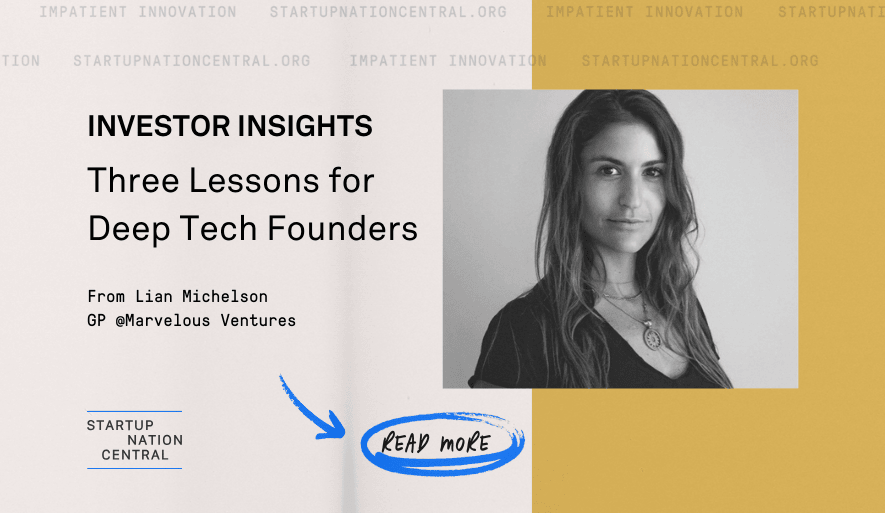
Insights From Lian Michelson, General Partner, Marvelous Ventures
At the MNC Summit 2025, hosted by Startup Nation Central, The Deep Tech Gamble explored what it takes to build and scale deep tech companies. For Lian Michelson, General Partner at Marvelous Ventures, deep tech is where research outweighs development, capturing both the opportunity and the pressure that define the field.
Deep Tech and Israel’s Edge
Israel has become a global leader in deep tech, home to roughly 1,000 startups operating at the intersection of advanced science and applied technology. Investment in the sector has grown sharply, and Israel now ranks second in the world for deep tech investment according to the Israel Innovation Authority. The country’s mix of world-class research, entrepreneurial culture, and tight collaboration between academia, industry, and investors has made it a strong hub for transformative innovation.
Deep tech startups typically emerge from research institutions or university spinouts and develop technologies that require long development cycles, significant funding, and specialized scientific expertise. What distinguishes Israel is its ability to move scientific ideas out of the lab and into the market. Its ecosystem encourages founders to take scientific risks while maintaining a relentless focus on real-world application.
Drawing on her experience working with early-stage founders, Lian Michelson outlined three lessons that capture what it really takes to turn deep research into scalable business
Lesson One: Start With Customers Early
One of the greatest challenges for deep tech founders is the long gap between invention and market adoption. Many spend years refining technology before speaking to potential customers, which can lead to products that miss market needs. Michelson urges founders to engage with customers early in the journey, even when the technology is still in development.
Early conversations reveal how industries define value, what barriers exist, and how buyers evaluate risk. This understanding helps founders direct their R&D toward solutions that customers actually want and will eventually pay for. It also allows them to identify use cases and pilot opportunities that can validate their technology sooner.
Engaging customers early does not mean compromising scientific integrity. It means ensuring the science stays relevant. Founders who understand their customers’ perspective from the start can prioritize research milestones that align with market realities, helping them avoid wasted time and resources.
Lesson Two: De-Risk Through the Customer’s Eyes
Many deep tech ventures fail not because the technology fails, but because customers cannot justify the risk of adopting something new. Michelson highlights that founders must learn to see their company through the eyes of the buyer. Understanding how potential customers assess risk, what proof points they require, and how they make decisions can make or break the adoption process.
Founders should ask what kind of validation is most persuasive to their market. Do customers need lab data, regulatory approval, field testing, or cost-benefit analysis? Once founders identify these requirements, they can build them into their business and development plans.
This approach also strengthens investor confidence. Companies that understand how to de-risk their path to adoption demonstrate maturity and commercial awareness. In an investment environment where capital favors proven execution, founders who anticipate buyer concerns stand out.
Lesson Three: Build for Multiple Partners
Customer engagement is critical, but over-reliance on a single partner can limit a company’s flexibility and scale. Founders often start by working with one large customer or corporate partner, which provides initial validation and funding. However, tailoring a product too closely to one client’s needs can restrict future growth.
Michelson advises founders to build with several partners across an industry. Working with multiple customers reveals patterns, shared pain points, and diverse use cases. It also protects startups from the volatility of depending on one buyer. When founders design adaptable solutions that address industry-wide challenges, they unlock broader markets and create more defensible business models.
This approach not only spreads risk but also accelerates credibility. When a product is validated by several customers in different contexts, it signals scalability and market readiness. That credibility attracts additional partners and investors who want to see proven, repeatable success.
The Mindset That Drives Deep Tech Success
Deep tech success depends on an obsession with the problem rather than the technology. Founders must have a clear understanding of what they are solving, who they are solving it for, and why their solution offers a measurable improvement. The most successful founders are those who combine deep scientific understanding with commercial insight.
They know how to translate complex research into practical solutions that make economic sense. They also know how to communicate value to investors, partners, and customers who may not share their technical background. This ability to bridge the gap between science and business is what turns breakthrough ideas into scalable companies.
Israel’s ecosystem provides fertile ground for this mindset. The country’s founders have a reputation for curiosity, creativity, and resilience. Increasingly, they are applying those qualities to build deep tech ventures that take time, discipline, and global perspective. The new generation of Israeli innovators is learning that commercial fluency is just as critical as technical mastery.
Looking Ahead
Deep tech is not a quick win. It demands focus, patience, and the ability to balance vision with execution. It rewards those who think long term and who can navigate both scientific uncertainty and market complexity.
Israel’s next wave of innovation will come from founders who can combine deep research with practical strategy. These are the entrepreneurs who will turn scientific discovery into sustainable industries and long-term economic impact.
Deep tech is where conviction meets endurance. The founders who master both will define the next decade of innovation and ensure that Israel continues to lead where science and entrepreneurship meet.
Based on insights shared by Lian Michelson, General Partner at Marvelous Ventures, during Startup Nation Central’s MNC Summit 2025, and contextualized with data and analysis from Startup Nation Central ecosystem reports.