 Why Israel
 Tech Ecosystem
 Human Capital
 Focus Sector
 The Health Network
 Business Opportunities
 Investment in Israel
 Innovation Diplomacy
 Leadership Circle
 Our Building
 Newsletter
 From The Press
 Startup Terms Glossary
 Tech Event Calendar



Innovation diplomacy is becoming a strategic advantage for founders building companies that need global reach. It connects startups with governments, multinationals, and public-sector institutions that are searching for technologies that solve real challenges. It also creates new pathways to market entry, funding opportunities, policymaker visibility, and long-term partnerships.
As technology becomes central to national resilience and economic growth, founders who understand innovation diplomacy can operate more effectively in a world that rewards collaboration, speed, and strategic alignment. This guide explains what innovation diplomacy means today, how it differs from tech diplomacy, why Israel has become a global leader in this space, and how Startup Nation Central supports founders who want to scale across borders.
What Is Innovation Diplomacy
Innovation diplomacy is the use of technology, entrepreneurship, and research capacity to build international relationships and develop solutions that address shared challenges. It creates structured collaboration between governments, innovators, investors, and global corporations.
For founders, innovation diplomacy delivers concrete opportunities. It expands access to international markets, connects startups with public-sector buyers and strategic partners, and provides visibility at moments when governments explore new capabilities in areas like climate resilience, cybersecurity, health system modernization, mobility, and digital transformation.
Short examples highlight the value:
- Israeli water technology companies have partnered with countries facing extreme drought.
- Cybersecurity companies have worked with national agencies that need to upgrade critical infrastructure.
- Health tech startups have collaborated with foreign health systems implementing digital tools.
Innovation diplomacy makes these opportunities possible by aligning needs with solutions.
Difference Between Innovation Diplomacy and Tech Diplomacy
Innovation diplomacy and tech diplomacy overlap but serve different purposes.
Tech diplomacy focuses on regulation, governance, and geopolitical implications of technology. It involves digital policy, AI standards, data protection, security frameworks, and global technology agreements.
Innovation diplomacy focuses on collaboration through solutions. It creates opportunities for startups to work directly with governments, cities, public institutions, and cross-border partners. For founders, innovation diplomacy may accelerate market entry, commercial pilots, and investor exposure.
How Israel Turned Innovation into a Global Diplomatic Asset
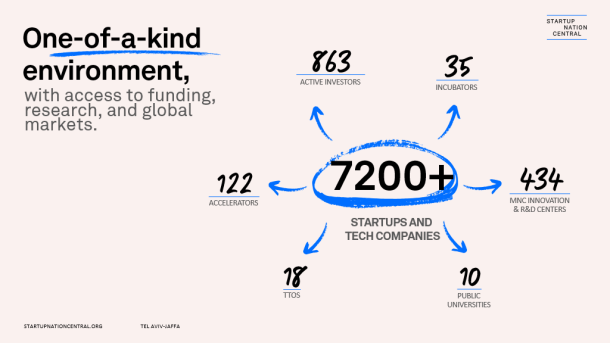
Israel has become a focal point for innovation diplomacy because of its dense and highly adaptive tech ecosystem. The country hosts more than 7,000 startups, strong academic research, and nearly 450 multinational R&D centers. Innovation contributes about 20% of GDP and a significant share of exports, turning technology into a national economic engine.
This environment attracts delegations from around the world. Governments visit Israel to learn how innovation is built, how ecosystems scale, and how startups commercialize solutions quickly. They explore sectors like AI, cybersecurity, digital health, agri-food, climate tech, and semiconductors. They look for models they can apply at home.
Startup Nation Central plays a central role in this engagement. Through its data platform, Finder, and its global partnership work, Startup Nation Central helps leaders understand Israel’s innovation landscape and meet the innovators building technologies that address their national needs. The diplomatic value of innovation is also demonstrated in real collaborations across the Middle East.
Why Founders Should Care: Strategic Advantages
Innovation diplomacy is more than an international relations concept; it is a practical commercial tool. Founders benefit when they understand how governments, public authorities, and international institutions adopt technology.
Market access and global partnerships
Global markets open faster when founders can align with national priorities. Governments worldwide are looking for water technologies, food security tools, digital health solutions, AI infrastructure, cyber defense platforms, and climate resilience products.
Credibility and visibility
Governments and public-sector buyers assess risk differently from investors. Startups included in innovation programs, delegations, and policy-level discussions gain credibility that strengthens their market positioning. Visibility in these channels improves trust and accelerates adoption.
Funding and pilot opportunities
Many countries operate innovation funds, bilateral R&D programs, and early pilot initiatives. These opportunities supplement venture capital and give founders access to budgets that support large-scale implementation.
Practical Steps for Founders to Engage in Innovation Diplomacy
Founders can begin engaging in innovation diplomacy by taking structured and intentional steps. This process does not require a public-sector background. It simply requires understanding how to align technology with global needs.
- Map markets that match the startup’s value proposition
Countries publish climate strategies, AI policies, national health plans, and digital transformation frameworks. These documents reveal demand for specific technologies. - Translate the startup’s value into public-sector language
Governments prioritize resilience, efficiency, cost management, and citizen impact. Pitches that speak directly to these outcomes resonate more clearly. - Participate in foreign delegations and ecosystem engagements
Israel hosts frequent delegations focusing on cybersecurity, AI, smart agriculture, digital health, mobility, and climate technology. These sessions create direct entry points to international markets. - Work with embassies, economic missions, and development agencies
Diplomatic entities often scout for technologies that fit their national priorities. Founders gain visibility by sharing capabilities with them. - Use ecosystem data to establish credibility
Tools like Finder support founders with accurate insights into sector dynamics, investors, competitors, and relevant market trends. - Build multi-company offerings when possible
Governments often want integrated solutions. Startups that collaborate with peers can present stronger offerings.
How Startup Nation Central Helps Founders Go Global
Startup Nation Central provides founders with structured support through innovation diplomacy.
Curated introductions to international partners
Startup Nation Central connects founders with relevant programs, public-sector organizations, and multinational corporations.
Visibility through the Finder platform
Finder highlights Israeli startups to global investors, foreign governments, and corporations exploring innovation partnerships.
Delegation programming and cross-border engagement
Startup Nation Central prepares founders for international exposure, including delegations, policy exchanges, and innovation summits.
Sector-specific expertise
Startup Nation Central supports founders with insight into global demand across climate tech, cyber, health tech, AI, semiconductors, and other strategic sectors.
The Future of Innovation Diplomacy: 5 Trends Founders Should Watch
Innovation diplomacy is expanding as more countries prioritize technology for national resilience. Several trends will shape how founders engage with global markets.
- AI as a strategic priority
Governments are building AI strategies and investing in data infrastructure and talent. Startups building AI products or tools will find new entry points. - Climate resilience and sustainability
Regions facing water scarcity, extreme weather, and agricultural disruption are increasing investment in resilience technologies. - Health system modernization
Countries upgrading healthcare infrastructure want digital tools, predictive analytics, and remote-care platforms. - Semiconductor and deep tech collaboration
Nations are strengthening technological independence. Israeli strengths in chip design, compute systems, and advanced materials will be important. - Middle East regional integration
Technology is shaping new diplomatic and economic relationships across the region.
Key Takeaways for Founders
Innovation diplomacy provides founders with direct pathways into global markets, stronger partnerships, and increased credibility.
- Innovation diplomacy accelerates market access, funding, partnerships, and visibility.
- Innovation diplomacy focuses on solving problems. Tech diplomacy focuses on governance.
- Israel’s innovation ecosystem is a global model and diplomatic asset.
- Founders benefit from early engagement with governments and public-sector institutions.
- Participation in delegations increases trust and speeds adoption.
- Data from Finder strengthens credibility in cross-border conversations.
- Multi-startup partnerships enhance value for public-sector buyers.
- Startup Nation Central enables global expansion with introductions, insights, and engagement programs.
- AI, climate tech, digital health, and semiconductors will drive future demand.
- Founders who embrace innovation diplomacy gain long-term strategic advantage.
Final Thoughts
Innovation diplomacy links technology with international priorities and strengthens relationships across borders. Israel’s innovation ecosystem demonstrates how this approach can create new opportunities for governments and startups alike.
Startup Nation Central supports these connections by giving founders access to the data, partnerships, and platforms they need to expand globally. As countries increase their investment in innovation, founders who understand innovation diplomacy will be positioned to lead.